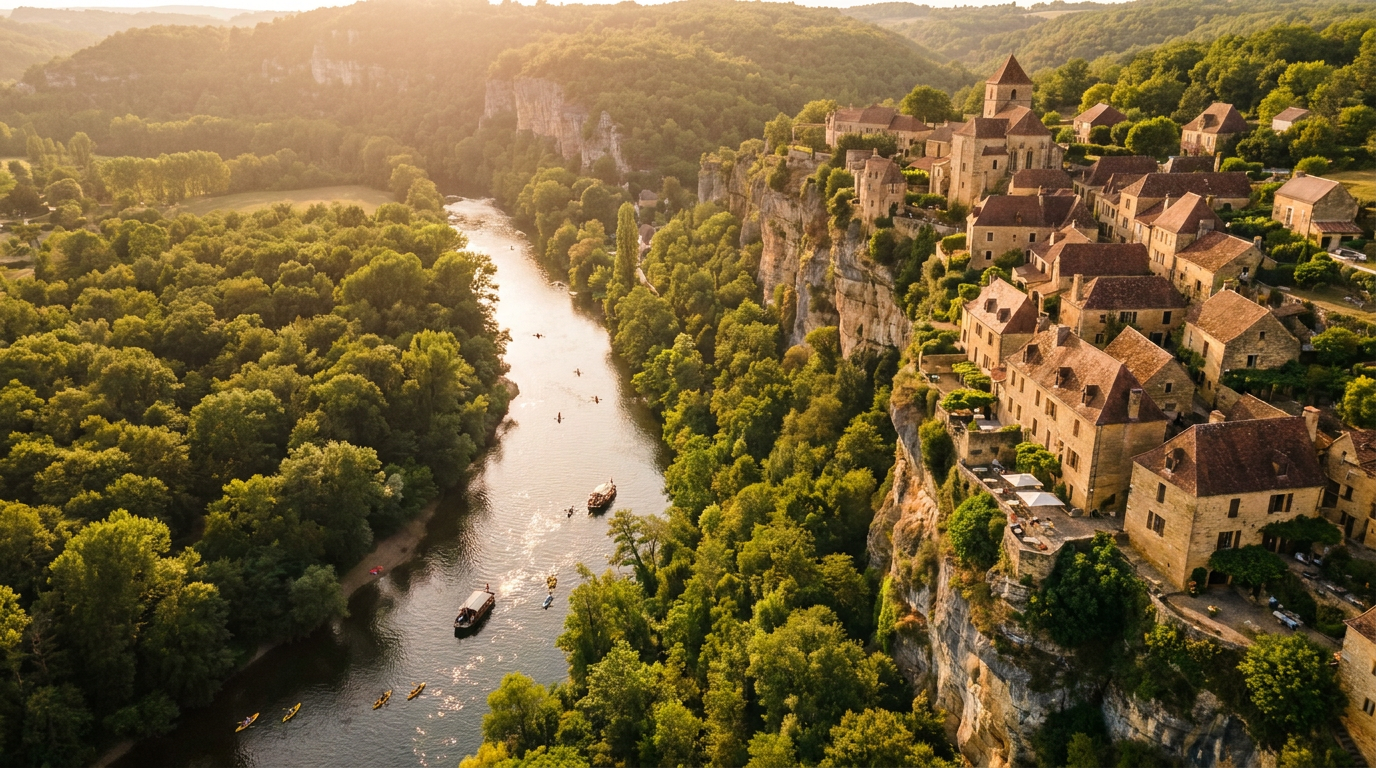
While the rest of the world races to Provence and the Loire, the Dordogne sits in France's southwest, largely overlooked by international tourists and beloved by those who've discovered it. I've been bringing clients here for decades, and the reaction is always the same: they cannot believe they waited so long. The region offers something increasingly rare in European travel: genuine depth. History layered upon history, landscape that asks you to slow down, and a culinary tradition that has resisted the impulse to modernize itself into something unrecognizable.
The Dordogne is officially known as Périgord, divided into four color-coded zones that correspond to their dominant features: Périgord Noir for truffle country, Périgord Blanc for the limestone plateau, Périgord Vert for the green northern forests, and Périgord Pourpre for the vineyards. Most visitors confine themselves to the Noir and are already overwhelmed by what they find. I suggest two weeks minimum and still send clients home with a list of what to do next time.
A Prehistoric Dimension Unlike Anywhere Else
The Lascaux cave paintings replica at Lascaux IV is, I will say it plainly, extraordinary. The original cave was closed to the public in 1963 to preserve the paintings from the damage caused by visitor breath and body heat, but the replica (built using the same digital scanning and pigment techniques as the originals) is so faithful that standing before a 17,000-year-old painting of a charging bison, you forget entirely that you are not in the original cave. The effect is not diminished by knowing it is a reproduction. The power comes from the images themselves, from the realization that human hands made these marks seventeen millennia before Rome was founded.
The Abri du Cap Blanc and Font-de-Gaume add further dimensions. The former has a remarkable frieze of actual carved horses in low relief; Font-de-Gaume is one of the last caves where you can see original polychrome prehistoric paintings by appointment. The Dordogne contains more significant prehistoric sites than anywhere else in Europe, concentrated in the Vézère Valley, which UNESCO recognized as a World Heritage Site in 1979. No other region in France, or indeed in Europe, offers this encounter with the deep human past in such density and such quality.
"There is a village in the Dordogne called Beynac-et-Cazenac, perched above a curve in the river with a medieval château crowning the cliff above. I have stood in that village at dusk, with the light turning gold on the stone, and thought: this is why we travel."
The Châteaux Circuit
The Dordogne's medieval heritage is as impressive as its prehistoric one. Château de Castelnaud, perched above the river in direct sightline of its rival Beynac across the valley, houses an extraordinary medieval weaponry museum: trebuchets, crossbows, suits of armor, and siege equipment explained with the kind of scholarly passion that makes you understand that the Middle Ages were not dark at all, merely different. The Château des Milandes is a different kind of monument entirely, Josephine Baker's beloved home, now restored to its original 1930s Art Deco splendor with a permanent exhibition about her life that is genuinely moving. She bought the château in 1947 and filled it with her Rainbow Tribe, twelve adopted children from twelve different countries. The house still feels inhabited by her spirit.
The wine estates of Monbazillac, producing one of France's great sweet wines from grapes affected by noble rot on fog-prone hillsides above the Dordogne, complete a châteaux circuit that encompasses military history, cultural biography, and oenological achievement in a single afternoon's drive.
The Food
Périgord Noir takes its name from the black truffle, and the truffle markets of winter are among the most remarkable food experiences in France. Particularly extraordinary is the Saturday market in Sarlat-la-Canéda from November through March. The Tuber melanosporum arrives in brown paper bags, weighed by hand on small scales, priced by a market that shifts weekly with supply and demand. Vendors slice a thumbnail-sized piece and hold it under your nose. The smell is unlike anything else: deep, earthy, almost mushroom but richer, older, more complicated.
Beyond the truffle, Périgord offers walnut oil pressed from the orchards you pass on every road, duck confit prepared with a care the industrial version sold in vacuum pouches at airport duty-free stores never captures, and foie gras produced by farmers who regard the quality of their product as a personal matter. The Tuesday market in Sarlat is one of the finest outdoor markets in France. I go every time I visit, and I come back to my rental kitchen with more ambition than skill, but the ingredients are so good that the cooking almost takes care of itself.
How to Base Yourself
Sarlat-la-Canéda is the best hub for a Dordogne visit: medieval, beautiful, remarkably well-preserved, walkable, with excellent restaurants and accommodation across several categories. The old town's golden limestone architecture is extraordinary. Barely a building postdates the 17th century in the historic center, which means even a walk to the boulangerie is an architectural experience. A rental car is essential; the Dordogne is a landscape you drive through as much as you walk through, and the roads between villages and châteaux are part of the pleasure, not merely the logistics.
Two weeks here barely scratches the surface, which is precisely why clients who come once almost always return. The Dordogne rewards return visits more than most destinations. The second trip, you'll find the restaurant the locals actually go to. The third, you take the kayak down the river at dawn and understand why people buy houses here and never fully leave.

